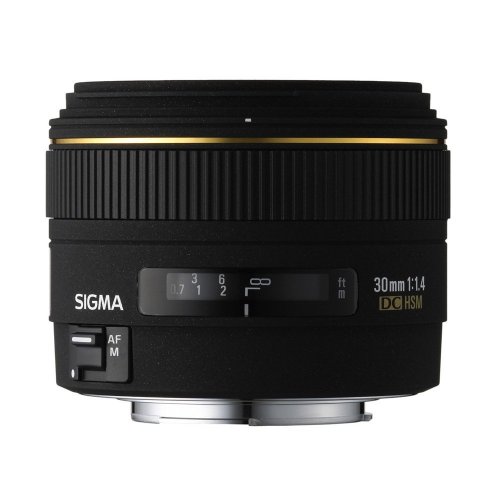
Sale Price : $439.00
Availibility : Usually ships in 24 hours

Sigma 30mm f/1.4 EX DC HSM Lens for Canon Digital SLR Cameras Overview
Includes Sigma 30mm f1.4 EX DC HSM Lens for Canon Digital EOS AF Lens caps Lens hood.…Read More product detail
Sigma 30mm f/1.4 EX DC HSM Lens for Canon Digital SLR Cameras Features
- 30mm focal length
- 2 low-dispersion glass elements; glass mold aspherical lens element
- 45-degree angle of view
- 15.7-inch minimum focusing distance
Sigma 30mm f/1.4 EX DC HSM Lens for Canon Digital SLR Cameras Best Review
The Sigma 30mm 1.4f is the lens that hits the sweet spot on focal length, aperture and price. This lens was made to fit a cropped sensor like the Canon T2i (550d) Digital SLR body. The cropped sensor is 1.6x, so 30mm x 1.6 = 48mm equivalent on a full frame 35mm sensor like the Canon 5D Mark II. Because 48mm is very close to the natural focal length of the human eye (50mm) it is the perfect lens that is easy to work with on film and stills.I was looking for a movie lens for my Canon T2i that would have a nice wide aperture for incredible depth-of-field that cinema cameras have. I was really going for the Canon 1.4f or the 1.8f 50mm lens because of the popularity and the price. However, I soon discovered that these lenses were made almost 20 years ago, and were made for full frame sensors. If I put a 50mm lens on my T2i, it would become an 80mm lens. This bothered me because I would have to move the camera farther away from the actors and would result in lower sound quality. Also, because cinematic movies are cropped again, it’s best to give your subject lots of free space around the frame because their head might get cut off.
After researching videos on YouTube and [...]and some other lens review sites, I found that the Sigma 30mm was the lens I was looking for. Although it was not in my price range and more expensive than the Canon 50mm 1.4 lens, I wanted a lens that I wouldn’t have to upgrade to get that perfect human eye focal length, and also because of the crop factor. The Sigma lens was introduced into the market half a decade ago because no lens manufacturer had really filled this niche for DSLRs with a cropped sensor. Canon has lens that are 28mm and 35mm, but are quite expensive, considering that they were L (luxury) series lenses. This lens was the best bang for the buck.
As an emerging filmmaker, I wanted to upgrade from my kit lens which was the Canon 18-55mm 3.5/5.6f lens. I knew that most people would complement this lens with a telephoto zoom lens for less than 0, but what will that benefit me for filmmaking? Also, most lenses out there are zoom lenses. However, zoom lenses have higher apertures, and won’t really give me a good DOF. That is why I just went for a prime lens instead of a zoom lens.
In filmmaking, light is always a problem especially for low-budget films. However, this lens will just “gobble light up”. You don’t have to sacrifice ISO and slow shutter speeds anymore with this wide aperture lens.
Now if you are going to get this lens, here are some things I discovered:
Auto Focus – It’s a problem that plagues all lenses that have a wide aperture because the DOF is super shallow, and the camera will have a hard time to discern what it should focus on. If you want a sharper image, you can stop down to 2.0 and will be much more adequate for shaper photos. If you are using this lens for video, you won’t really notice how sharp it is. However, if you really want a super sharp photo, this lens won’t be what you are looking for.
Full-time Auto Focus – You can override auto focus if you decide to focus on something else without switch the mode to manual.
It’s not a kit lens – It is professional lens (EX) that is completely made metal and glass. On my T2i (which is a plastic body), you can feel the difference in weight!
It comes with a case and a lens hood! Make sure you get a UV lens filter. I got the Sunpak 62mm UV Filter. It’s cheap but durable.
If you haven’t upgraded your audio, you should look for the RODE Shotgun VideoMic (which is Mono) or the RODE Stereo VideoMic SVM. These microphones by RODE are professional quality mics that are specifically made for camcorders and DSLRs that capture film. Both of them have a hotshoe mount and use the 3.5mm audio minijack that can plug into your DSLR’s mic in. However, if you want to use professional equipment that uses XLR jacks, you will need to get an audio recorder like the ZOOM H4N.
Hope that helps! Thanks for reading!
Sigma 30mm f/1.4 EX DC HSM Lens for Canon Digital SLR Cameras RelateItems
- Tiffen 62mm UV Protection Filter
- Sigma 62mm Multi-Coated UV Filter
- B+W 62mm UVA (Ultra Violet) Haze MRC Filter #010
- Canon EOS 7D 18 MP CMOS Digital SLR Camera with 3-inch LCD (Body Only)
- Canon LP-E6 Battery Pack for Select Canon Digital SLR Cameras

http://godaddycare.blogspot.com
ReplyDeletehttp://cheapsigmacameralens.savebargain.com/
ReplyDelete